
By Courtside · Research checked 26 October 2026 · 6 minute read
The short answer: Choose padel shoes by court surface, secure fit and support for sideways movement. Running sneakers are designed for a different job: forward travel. For padel’s repeated stops, turns and lateral pushes, a suitable court shoe is the better starting point. The most expensive pair is not automatically the best pair for your feet.
You can spend hours comparing racket faces, foam and balance, then walk onto court in the same shoes you wore for a morning jog. It is an easy mistake. Your racket gets the attention. Your shoes do the groundwork.
Padel asks you to shuffle wide, recover towards the middle, move backwards to judge a lob and accelerate towards the net. A shoe that feels beautifully cushioned on a pavement may feel very different when you brake sideways on artificial turf.
Why running sneakers are the wrong default for padel
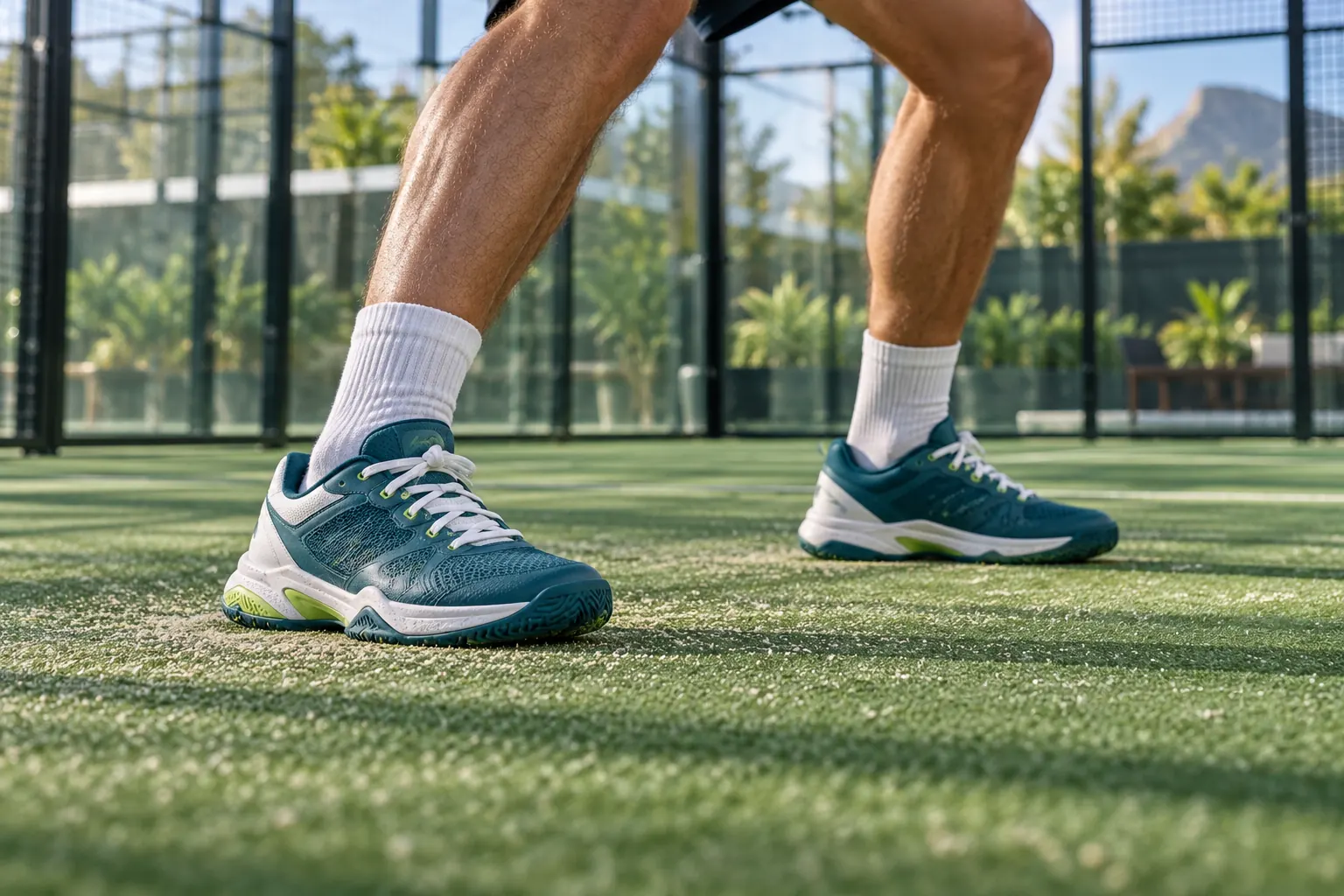
Running shoes are generally built around repeated forward movement. Court shoes have to manage movement in several directions. FILA South Africa’s equipment guidance specifically advises against running shoes for padel; ASICS also identifies lateral support as a key feature of court footwear. FILA’s padel guide, ASICS court footwear guidance.
That distinction matters more than the logo. Soft cushioning, a flexible upper or a tall platform can feel comfortable standing still without giving you the containment you want during a sideways stop. Designs differ, so assess the actual shoe rather than assuming every runner behaves identically.
Calling running sneakers a “recipe for disaster” makes the point, but an injury is not inevitable. The practical concern is using footwear that was not designed around the movement and surface demands of the game. No shoe guarantees injury prevention, and good footwear does not replace appropriate movement technique.
If your budget covers one immediate equipment upgrade, ask whether your current shoes are suitable before buying a more advanced racket.
Start with the court, not the colourway
Artificial turf is not one uniform surface. Ask your club what turf it uses and which outsole types it recommends. Visible sand, turf construction, wear and maintenance can all affect how a court feels.
Babolat describes padel outsoles that combine herringbone sections for sand with omni-style sections for artificial grass. That is useful evidence that padel tread is designed around the surface. It is not a rule that every court requires exactly the same pattern. Babolat’s padel outsole explanation.
You want predictable traction when starting and stopping. Do not select a shoe simply because someone describes it as having the “most grip”. Suitability depends on the whole shoe, your movement and the surface underneath it.
| What you play on | What to investigate | What to avoid assuming |
|---|---|---|
| Artificial turf with noticeable loose sand | A padel outsole intended for sand and turf; ask whether a clay-style herringbone option suits that installation | Every herringbone shoe suits every padel court |
| Textured turf with less visible loose sand | The manufacturer’s surface recommendation and your club’s advice | Less visible sand means an ordinary running sole is suitable |
| Several different padel venues | An appropriate, versatile padel outsole and predictable movement across those courts | One session proves suitability everywhere |
| A hard court used for another racket sport | Footwear specified for that sport and surface | Padel, tennis and pickleball surfaces are interchangeable |
Fit is where the decision becomes personal
Two players can wear the same size and need different shoes. Width, heel shape, forefoot volume and preferred socks all influence fit.
Try shoes with the socks you actually play in. If you use prescribed orthotics, check the fit with them rather than assuming they will slot comfortably into any model. Stand, walk and make a few controlled side steps on a suitable clean surface.
Look for a secure heel and midfoot, room for your toes and no obvious pressure points. Your foot should not slide around inside the shoe when you change direction. Equally, you should not need to crush your toes or overtighten the laces to feel secure.
Sizing systems vary between brands. Check the model’s size guide and the retailer’s exchange conditions before ordering. Keep the pair clean while assessing indoor fit. Do not assume you can play an outdoor match and then return a used shoe as an unworn size exchange.
What to compare beyond the outsole
Lateral support: Look for a court-focused construction that helps contain your foot during sideways movement. A shoe feeling soft does not tell you how it will behave under lateral load.
Cushioning: You still want comfort. Compare cushioning together with stability and fit, rather than treating extra softness as an automatic upgrade.
Upper and toe durability: If you drag a foot or spend long sessions on court, inspect reinforcement around high-wear areas. Ask about the exact model; a brand name alone does not describe its construction.
Ventilation and care: For warm sessions, consider breathability alongside support. After play, let shoes dry in a ventilated area and follow the maker’s cleaning instructions. Avoid leaving damp footwear sealed in a bag or baking in a parked car.
Playing frequency: A weekly social player and a coach spending many hours on court may place different demands on a pair. Buy for your real routine, including the amount of court time you expect over the next few months.
Can you use tennis shoes for padel?
Some court shoes may be suitable across more than one racket sport, but check the exact outsole and intended surface. “Tennis shoe” is not a single specification: manufacturers distinguish between hard-court, clay and other surface options. Babolat’s surface guide illustrates that difference. Babolat’s surface-specific sole guidance.
A clay-court tennis model may be an option for some padel installations. It should not be recommended automatically for every court. If you already own court shoes, send Courtside the exact model and tell us where you play before buying another pair.
When should you replace padel shoes?
Use condition rather than a promised number of months. Inspect the tread, uneven wear, damaged uppers, heel security and how the pair feels during ordinary movement. A shoe can still look presentable from above while the outsole is worn underneath.
Clean off loose debris before inspecting it. If movement starts feeling unpredictable, stop and investigate the shoes and court conditions. Persistent pain or a previous injury calls for advice from an appropriately qualified clinician, rather than choosing a shoe from a marketing claim.
Your Courtside buying checklist
Before ordering, know your usual court, playing frequency, measured size and preferred fit. Then compare surface suitability, lateral support, comfort and durability. Colour comes after those decisions.
Need a hand choosing? Browse Courtside’s equipment range, or email hello@courtside.co.za with your size, current shoe model and the courts you use. Play comes first. The right footwear helps you focus on it.
Quick answers
Frequently asked questions
- Can beginners play padel in running shoes?
- Running shoes are not the recommended default. Beginners still make sideways stops and turns. Start with an appropriate court shoe that fits securely and matches your venue’s surface guidance.
- Are the most expensive padel shoes always better?
- No. A premium model that does not fit your foot or suit your court is a poor purchase. Compare the relevant construction and fit before the price or professional endorsement.
- Does a padel shoe prevent ankle injuries?
- No shoe can guarantee that. Appropriate footwear is one part of preparing to play, alongside technique, court conditions and individual health needs.