
By Courtside · Research checked 26 October 2026 · 7 minute read
The short answer: For 2027, South African pickleball clubs should prioritise repeatable beginner sessions, appropriate court space, equipment consistency and clear event formats. Our expectation is that dependable weekly play will matter more than launch-day attention. This is Courtside’s planning outlook, not a verified forecast of national player numbers or guaranteed club returns.
A successful introductory event can make pickleball feel like an obvious next step for a club. People learn, laugh and ask when they can come back. The test is whether there is a useful answer to that question.
A good programme needs somewhere suitable to play, a manageable route into the game and equipment that players can understand. Build those foundations before assuming a crowded opening event will become a full calendar.
1. Beginner programmes will need a clear next step
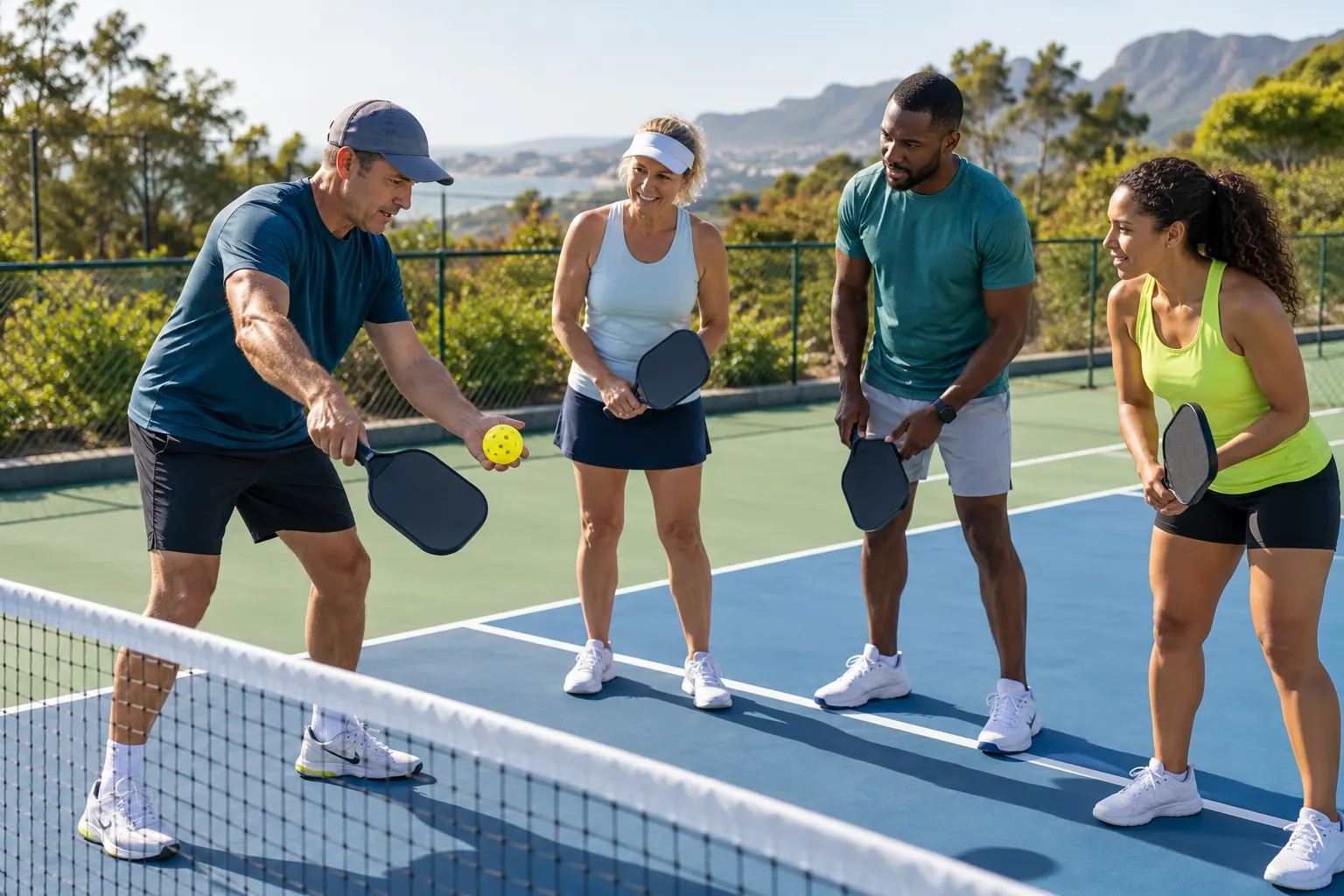
Our first recommendation for 2027 is to connect introductory sessions to a recurring programme. Offer a published route from first lesson to supervised social play, then towards more competitive sessions where appropriate.
A newcomer should know whether equipment is supplied, what footwear is expected, how long the session lasts and whether they need a partner. Explain what happens when they arrive. Avoid making the first experience depend on finding an unadvertised WhatsApp group or already knowing someone at the club.
This approach is consistent with USA Pickleball’s facility-development guidance, which identifies beginner pathways, skill-based programming, leagues and clinics as ways to support repeat play. That guidance comes from the US and needs adapting to local facilities and customers. USA Pickleball’s facility growth guidance.
2. Existing facilities will remain worth investigating
South African examples show that pickleball does not have to begin with a purpose-built standalone venue. Country Club Johannesburg lists pickleball at its tennis facilities. Rietondale describes developing courts from existing club space and building an interclub competition pathway. Country Club Johannesburg, Rietondale Pickleball Club.
These examples suggest possibilities, not a promise that any spare tennis court can be converted cheaply. Inspect the surface, drainage, access, net arrangement and surrounding space. Agree who has priority when tennis, coaching and pickleball programmes overlap.
For a shared venue, the timetable is part of the design. A technically workable layout is of limited value if players regularly arrive to find another activity occupying their booking.
3. Space around the lines will matter as much as the lines
The marked pickleball court is 6.10 metres wide and 13.41 metres long. USA Pickleball’s 2026 rulebook specifies a minimum playing surface of 9.14 by 18.29 metres, with larger dimensions recommended for new construction and tournament play. The boundary lines and the total playing area are different things. USA Pickleball’s official rulebook.
Do not plan a facility by fitting as many marked rectangles as possible into the available footprint. Players need space beyond the boundaries, and a venue also needs circulation, waiting areas and sensible separation from adjacent activity.
Use the current rules and qualified design advice for the proposed layout. Confirm the standards required by the specific competition organiser. International guidance is useful technical input; it is not permission to build or a replacement for local approvals.
4. Noise should be considered before complaints arrive
Pickleball’s sound deserves attention when courts sit close to homes, offices or other sensitive uses. USA Pickleball has developed acoustic guidance and equipment noise categories, recognising that the issue extends beyond the paddle alone. USA Pickleball’s acoustics guidance.
For a South African venue, assess the actual site: neighbouring buildings, operating hours, simultaneous courts and the direction sound travels. Where warranted, get a competent acoustic assessment before committing to a layout or promising long evening hours.
Quieter equipment may form part of an approach, but a product label does not establish that a site meets local requirements. Confirm the exact equipment’s suitability for your competition as well as its noise characteristics. A nearby resident experiences the whole session, not a single equipment specification.
5. Equipment decisions will become more deliberate
A club does not need a rack full of near-identical premium paddles to introduce the sport well. Start with manageable choices that suit the people attending, including grip size, weight and condition.
Separate your rental and demonstration equipment from new retail stock. Label club paddles, inspect them regularly and record damage or missing items. A demo programme only helps if staff know which paddle was used and can explain a meaningful difference.
For competitions, check the exact paddle and ball against the rules adopted by that event. USA Pickleball maintains an equipment database, but approval for one body or format should not be presented as universal approval for every tournament. USA Pickleball’s equipment database.
Buy replacement balls consistently. Test the selected model on your surface rather than changing ball types unexpectedly between rounds. Publish the competition ball in advance so participants know what to expect.
6. Accessible competition can sit between socials and major events
Our expectation is that clubs will benefit from formats that give improving players a reason to return without requiring an immediate jump into high-pressure tournaments.
A short ladder, round-robin evening or recurring doubles league can create that bridge. Tell players how teams are formed, what ability level the session serves, how long they will play and how disputes are handled.
Be realistic about capacity. A long entry list can look successful while leaving customers waiting through most of the event. Work backwards from courts, time slots, expected match length and your chosen format. Include changeovers and delays in the schedule rather than treating every minute as playing time.
7. Measure retention alongside attendance
Use a small, consistent dashboard. Suggested measures include first-time attendees, players returning within 30 days, paid places filled, cancellations, revenue per session and contribution after direct costs. These are planning suggestions, not industry benchmarks.
Ask players one useful question after a session: “What would make it easier for you to play again?” A small change to timing or communication may be more valuable than another launch promotion.
| What you observe | What to investigate | A practical response |
|---|---|---|
| Introductory sessions fill, but few people return | Is the next session clear and appropriate? | Offer a regular follow-on group |
| Social players avoid competitive sessions | Are levels or formats mismatched? | Separate the session promise more clearly |
| Equipment disappears or wears unexpectedly | Are issue and inspection records missing? | Number club equipment and log its use |
| Events sell out but attract complaints | Is waiting time or communication poor? | Review capacity and publish a clear schedule |
A 90-day planning example
In the first month, assess the venue, confirm the equipment and publish one recurring beginner session. In the second, add a clearly described follow-on social and track repeat attendance. In the third, test a modest league or event if there is enough demand and organisational capacity.
Use each stage to learn. The aim is a programme players trust, with costs and responsibilities the club can manage.
Preparing a club range? Speak to Courtside about your equipment requirements. Start with player numbers, session frequency and surface information so you can build a useful shortlist.
Quick answers
Frequently asked questions
- What is the biggest pickleball opportunity for clubs in 2027?
- Courtside’s view is that making repeat participation easy is the most practical opportunity: reliable sessions, clear ability groups and suitable equipment. Local demand should guide expansion.
- Can a tennis club add pickleball?
- Potentially. Check safe playing space, surface condition, scheduling, noise and the applicable approvals before deciding how to use or alter the facility.
- Will a USA Pickleball-approved paddle be accepted at every event?
- Do not assume so. Confirm the exact event’s adopted rules and equipment requirements, and check the specific model’s current status.